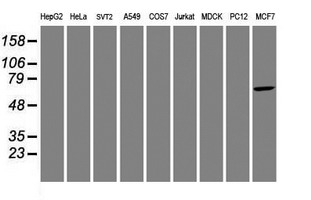
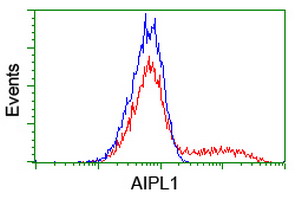
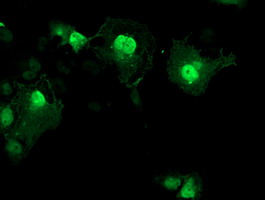
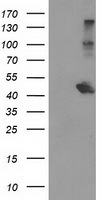
AIPL1 antibody
Principal name
AIPL1 antibody
Alternative names for AIPL1 antibody
Aryl-hydrocarbon-interacting protein-like 1
Ncbi ID
NP_055151, 9606, NP_001028226.1, NP_444475.2, BC028285, NM_053245, NM_021590, NM_001033054
Available reactivities
Available hosts
Available applications
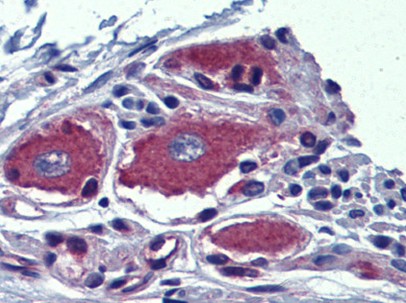
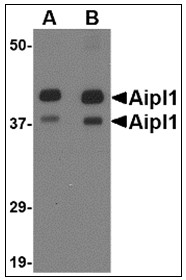
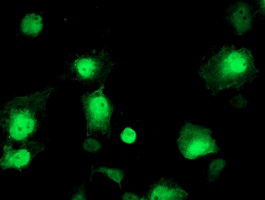
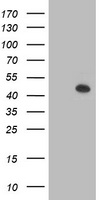
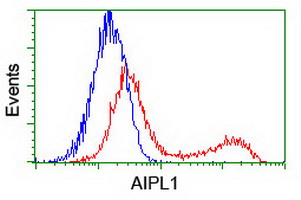
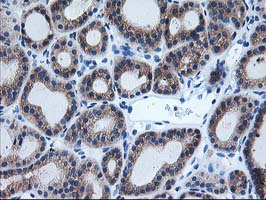
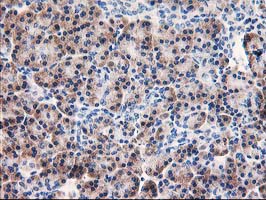
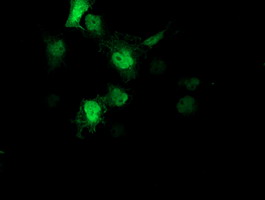
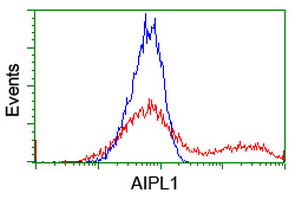
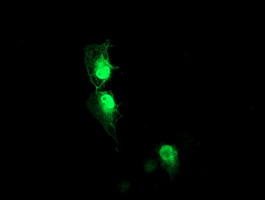
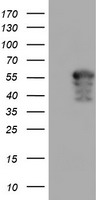
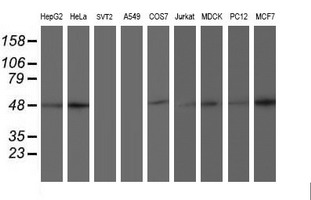
Enzyme Immunoassay (E), Western blot / Immunoblot (WB), Paraffin Sections (P), ELISA (detection) (E(detection)), EPair for Elisa (EPair), Flow Cytometry (F), Immunocytochemistry/Immunofluorescence (ICC/IF), Luminex (LMNX)
Background of AIPL1 antibody
Aipl1 was initially identified as a protein implicated in Leber congenital amaurosis (LCA), an autosomal recessive disorder thought to be caused by the abnormal development of photoreceptors. Aipl1 is a tetratricopeptide repeat protein that is highly homologous to ARA9, a protein involved in the HSP90-mediated nuclear translocation and transactivation of the aryl hydrocarbon receptor. Aipl1 has also been found to function as part of a chaperone heterocomplex, interacting with Hsp90 and Hsp70. Aipl1 also associates with the cell cycle regulator NUB1. It is thought that Aipl1 cooperates with Hsp70 but not Hsp90 to suppress the formation of NUB1 inclusions, and these interactions are necessary in the normal photoreceptor maturation, as mutations that lead to LCA also compromise the interactions with the Hsp chaperones. At least three isoforms of Aipl1 are known to exist.











Proteins & Growth Factors
| Catalog No. | Species | Pres. | Purity | Source | |
|---|---|---|---|---|---|
| TP304079 | AIPL1 (transcript variant 1) |
||||
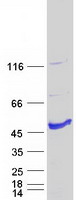
| Recombinant protein of human aryl hydrocarbon receptor interacting protein-like 1 (AIPL1), transcript variant 1 | |||||
 |
Human | > 80 % Preparation: Recombint protein was captured through anti-DDK affinity column followed by conventiol chromatography steps. Purity Detail: > 80% as determined by SDS-PAGE and Coomassie blue staining. |
HEK293 cells |
20 µg /
€748.00
|
|
| OriGene Technologies, Inc. | |||||