Beta-crystallin B1 antibody
Principal name
Beta-crystallin B1 antibody
Alternative names for Beta-crystallin B1 antibody
CRYBB1, Beta-B1 crystallin
SwissProt ID
P02523 (Rat), P07318 (Bovin), P07530 (Chick), P53674 (Human), Q007T1 (Pig), Q9WVJ5 (Mouse)
Ncbi ID
9606, NP_001878.1, NP_001878, NM_001887, NP_076184.1, NM_023695, NM_012936
Available reactivities
Available hosts
Available applications
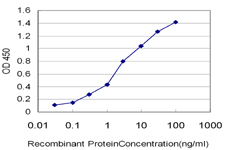
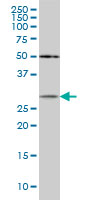
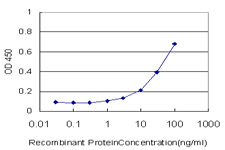
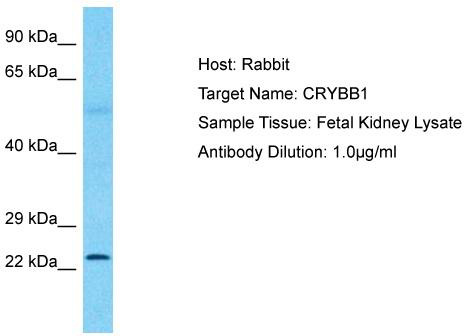
Enzyme Immunoassay (E), Western blot / Immunoblot (WB)
Background of Beta-crystallin B1 antibody
Crystallins are separated into two classes: taxon-specific, or enzyme, and ubiquitous. The latter class constitutes the major proteins of vertebrate eye lens and maintains the transparency and refractive index of the lens. Since lens central fiber cells lose their nuclei during development, these crystallins are made and then retained throughout life, making them extremely stable proteins. Mammalian lens crystallins are divided into alpha, beta, and gamma families; beta and gamma crystallins are also considered as a superfamily. Alpha and beta families are further divided into acidic and basic groups. Seven protein regions exist in crystallins: four homologous motifs, a connecting peptide, and N- and C-termil extensions. Beta-crystallins, the most heterogeneous, differ by the presence of the C-termil extension (present in the basic group, none in the acidic group). Beta-crystallins form aggregates of different sizes and are able to self-associate to form dimers or to form heterodimers with other beta-crystallins. This gene, a beta basic group member, undergoes extensive cleavage at its N-termil extension during lens maturation. It is also a member of a gene cluster with beta-A4, beta-B2, and beta-B3.
General readings
Annunziata O., et al. (2005) Biochemistry. 44(4):1316-28.

Proteins & Growth Factors
| Catalog No. | Species | Pres. | Purity | Source | |
|---|---|---|---|---|---|
| TP307718 | Beta-crystallin B1 |
||||
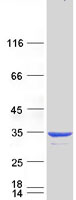
| Recombinant protein of human crystallin, beta B1 (CRYBB1) | |||||
 |
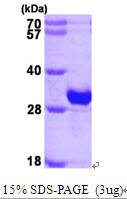
Human | > 80 % Preparation: Recombint protein was captured through anti-DDK affinity column followed by conventiol chromatography steps. Purity Detail: > 80% as determined by SDS-PAGE and Coomassie blue staining. |
HEK293 cells |
20 µg /
€748.00
|
|
| OriGene Technologies, Inc. | |||||
Lysates
| Catalog No. | ||
|---|---|---|
| LY419684 | CRYBB1 overexpression lysate |
|
 |
0.1 mg /
€295.00
|
|
| OriGene Technologies, Inc. |
Mouse Lenti ORF Particles
| Catalog No. | ||
|---|---|---|
| MR203610L2V | Lenti ORF particles, Crybb1 (GFP-tagged) - Mouse crystallin, beta B1 (Crybb1), 200 uL, >10^7 TU/mL |
|
|
200 µl /
€930.00
|
|
| OriGene Technologies, Inc. | ||
| MR203610L1V | Lenti ORF particles, Crybb1 (Myc-DDK-tagged) - Mouse crystallin, beta B1 (Crybb1), 200 uL, >10^7 TU/mL |
|
|
200 µl /
€830.00
|
|
| OriGene Technologies, Inc. | ||
Rat Lenti ORF Particles
| Catalog No. | ||
|---|---|---|
| RR215410L2V | Lenti ORF particles, Crybb1 (GFP-tagged ORF) - Rat crystallin, beta B1 (Crybb1), 200 uL, >10^7 TU/mL |
|
|
200 µl /
€930.00
|
|
| OriGene Technologies, Inc. | ||
| RR215410L1V | Lenti ORF particles, Crybb1 (Myc-DDK-tagged ORF) - Rat crystallin, beta B1 (Crybb1), 200 uL, >10^7 TU/mL |
|
|
200 µl /
€830.00
|
|
| OriGene Technologies, Inc. | ||

