CLCNKB antibody
Principal name
CLCNKB antibody
Alternative names for CLCNKB antibody
Chloride channel protein ClC-Kb, Chloride channel Kb, ClC-K2, ClCK2
Ncbi ID
NP_000076, NP_000076.2, 10090, AAH20873.1, NP_775126.1, NM_173103, NM_000085, NM_001165945
Available reactivities
Available hosts
Available applications
Western blot / Immunoblot (WB), Frozen Sections (C), Enzyme Immunoassay (E)
Background of CLCNKB antibody
CLC-Ka and CLC-Kb are members of the voltage-dependent Cl channel (CLC) family that includes nine known members in mammals. The human CLC-Ka and CLC-Kb (known as CLC-K1 and CLC-K2 in the rat) channels are closely related genes that share 94% sequence homology and identical genomic organization. CLC channels can be classified as plasma membrane channels and intracellular organelle channels. The first group includes the CLC-1, CLC-2 CLC-Ka and CLC-Kb channels. The second group comprises the CLC-3, CLC-4, CLC-5, CLC-6 and CLC-7. CLC channels that function in the plasma membrane are involved in the stabilization of membrane potential and in transepithelial transport. The presumed function of the intracellular CLC channels is support of the acidification of the intraorganellar compartment. In this regard, recent reports indicate that ClC-4 and ClC-5 (and by inference ClC-3) can function as Cl/H+ antiporters. The functiol unit of the CLC channels is a dimer with each subunit forming a proper pore. Although the crystal structure of bacterial CLC channels was resolved,the topology of the CLC channels is complex and has not been fully elucidated. It is generally accepted that both the N- and C- terminus domains are intracellular while the number and configuration of the transmembrane domains vary greatly between different models. CLC-K channels require the presence of the auxiliary b subunit barttin, a 34 kD transmembrane protein, for transport to the plama membrane and regulation of channel permeation and gating. CLC-K channels are expressed primarily in the kidney from the thin ascending limb to the collecting duct of the nephron, and in the stria vascularis and dark cells of the vestibular organ of the inner ear. The channels are important for rel salt reabsorption and water balance by ebling chloride exit across the basolateral membranes. The importance of the CLC-K channel in rel function is demonstrated by the fact that loss-of-function mutations in CLC-Kb lead to Bartter syndrome type III, an autosomal recessive disorder characterized by severe salt wasting, low blood pressure, hypokalemia and hypercalciuria.
General readings
Gorgojo,J.J., et al., (2006) Horm. Res. 65 (2), 62-68

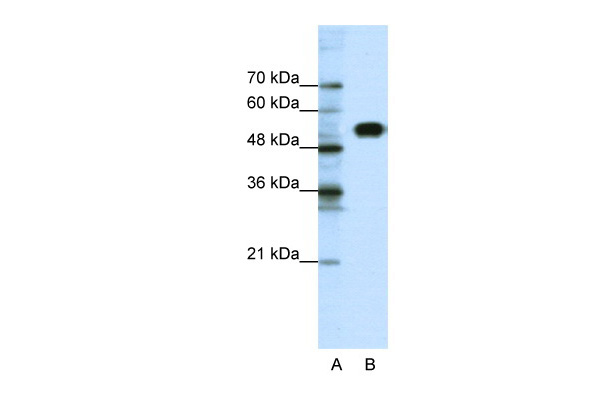
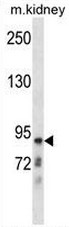
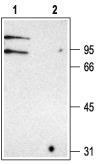
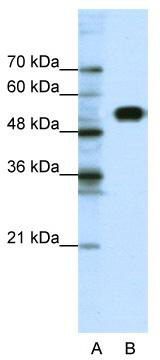
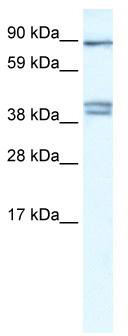
Primary Antibodies
| Catalog No. | Host | Iso. | Clone | Pres. | React. | Applications | |
|---|---|---|---|---|---|---|---|
| TA328781 | CLCNKB antibody |
||||||
| Rabbit Polyclonal Anti-CLC-K | |||||||
 |
Rabbit | Purified | Rt | WB |
0.2 ml /
€585.00
|
||
| OriGene Technologies, Inc. | |||||||
| AP50941PU-N | CLCNKB (N-term) antibody |
||||||
 |
Rabbit | Ig | Aff - Purified | Hu, Ms | WB |
0.4 ml /
€415.00
|
|
| OriGene Technologies GmbH | |||||||
| AP54844SU-N | CLCNKB antibody |
||||||
 |
Rabbit | Serum | Ms | C, E, WB |
0.2 ml /
€430.00
|
||
| OriGene Technologies GmbH | |||||||
Rat Lenti ORF Particles
| Catalog No. | ||
|---|---|---|
| RR213198L2V | Lenti ORF particles, Clcnkb (GFP-tagged ORF) - Rat chloride channel Kb (Clcnkb), 200 uL, >10^7 TU/mL |
|
|
200 µl /
€1,450.00
|
|
| OriGene Technologies, Inc. | ||
| RR213198L1V | Lenti ORF particles, Clcnkb (Myc-DDK-tagged ORF) - Rat chloride channel Kb (Clcnkb), 200 uL, >10^7 TU/mL |
|
|
200 µl /
€1,300.00
|
|
| OriGene Technologies, Inc. | ||