CLN8 antibody
Principal name
CLN8 antibody
Alternative names for CLN8 antibody
C8orf61
Ncbi ID
NP_061764, NP_061764.2, NP_036130.1, NM_012000, NM_001007686, NM_018941
Available reactivities
Available hosts
Available applications
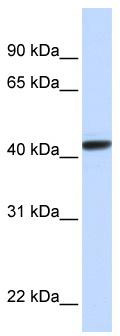
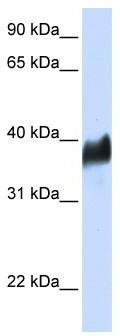
Western blot / Immunoblot (WB)
Background of CLN8 antibody
CLN8 is a transmembrane protein belonging to a family of proteins containing TLC domains, which are postulated to function in lipid synthesis, transport, or sensing. The protein localizes to the endoplasmic reticulum (ER), and may recycle between the ER and ER-Golgi intermediate compartment. Mutations in this gene are associated with progressive epilepsy with mental retardation (EMPR), which is a subtype of neuronal ceroid lipofuscinoses (NCL). Patients with mutations in this gene have altered levels of sphingolipid and phospholipids in the brain. Childhood-onset NCL are a group of autosomal recessive progressive encephalopathies characterized by the accumulation of autofluorescent material, mainly ATP synthase subunit C, in various tissues, notably in neurons. Based on clinical features, the country of origin of patients, and the molecular genetic background of the disorder, at least seven different forms are thought to exist. CLN8 is characterized by normal early development, onset of generalized seizures between 5 and 10 years, and subsequent progressive mental retardation.This gene encodes a transmembrane protein belonging to a family of proteins containing TLC domains, which are postulated to function in lipid synthesis, transport, or sensing. The protein localizes to the endoplasmic reticulum (ER), and may recycle between the ER and ER-Golgi intermediate compartment. Mutations in this gene are associated with progressive epilepsy with mental retardation (EMPR), which is a subtype of neuronal ceroid lipofuscinoses (NCL). Patients with mutations in this gene have altered levels of sphingolipid and phospholipids in the brain.
General readings
Hermansson,M., (2005) J. Neurochem. 95 (3), 609-617


Mouse Lenti ORF Particles
| Catalog No. | ||
|---|---|---|
| MR203926L2V | Lenti ORF particles, Cln8 (GFP-tagged) - Mouse ceroid-lipofuscinosis, neuronal 8 (Cln8), 200 uL, >10^7 TU/mL |
|
 |
200 µl /
€930.00
|
|
| OriGene Technologies, Inc. | ||
| MR203926L1V | Lenti ORF particles, Cln8 (Myc-DDK-tagged) - Mouse ceroid-lipofuscinosis, neuronal 8 (Cln8), 200 uL, >10^7 TU/mL |
|
|
200 µl /
€830.00
|
|
| OriGene Technologies, Inc. | ||
Rat Lenti ORF Particles
| Catalog No. | ||
|---|---|---|
| RR210419L2V | Lenti ORF particles, Cln8 (GFP-tagged ORF) - Rat ceroid-lipofuscinosis, neuronal 8 (Cln8), 200 uL, >10^7 TU/mL |
|
|
200 µl /
€930.00
|
|
| OriGene Technologies, Inc. | ||
| RR210419L1V | Lenti ORF particles, Cln8 (Myc-DDK-tagged ORF) - Rat ceroid-lipofuscinosis, neuronal 8 (Cln8), 200 uL, >10^7 TU/mL |
|
|
200 µl /
€830.00
|
|
| OriGene Technologies, Inc. | ||