KCNJ9 antibody
Principal name
KCNJ9 antibody
Alternative names for KCNJ9 antibody
KCNJ9, GIRK3, Inwardly rectifier K(+) channel Kir3.3, Potassium channel, inwardly rectifying subfamily J member 9, G protein-activated inward rectifier potassium channel 3
Ncbi ID
NP_004974.2, NP_004974, AAI67777.1, NM_004983, NP_446286.1, NM_008429, NM_053834
Available reactivities
Available hosts
Available applications
Western blot / Immunoblot (WB), Enzyme Immunoassay (E), Paraffin Sections (P)
Background of KCNJ9 antibody
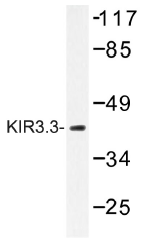
Kir3.3 (or G-protein regulated Inward-Rectifier K+ channel, GIRK3) is a member of the family of inward rectifying K+ channels. The family includes 15 members that are structurally and functiolly different from the voltage-dependent K+ channels. The family’s topology consists of two transmembrane domains that flank a single and highly conserved pore region with intracellular N- and C-termini. As is the case for the voltage-dependent K+ channels the functiol unit for the Kir channels is composed of four subunit that can assembly as either homo or heterotetramers. Kir channels are characterized by a K+ efflux that is limited by depolarizing membrane potentials thus making them essential for controlling resting membrane potential and K+ homeostasis. Kir3.3 is a member of the Kir3.x subfamily that includes four members (Kir3.1- Kir3.4). The Kir3 family is characterized by the fact that the channels can be activated by neurotransmitters and other factors acting via the activation of G-protein coupled receptors. Binding of the corresponding ligand to the G-protein receptor induces the dissociation of Ga-GTP from the Gbg dimer. The latter directly binds to Kir3 and activates the channel. Kir3.3 is mainly expressed in the brain, were it co-assembles with Kir3.1 or Kir3.2. The functiol impact of Kir3.3 is less well understood than the other Kir3 channels. However, heteromers composed of Kir3.2 and Kir3.3 were found to be primarily responsible for the opioid-induced current and hyperpolarization observed in mouse locus ceruleus (LC) neurons.


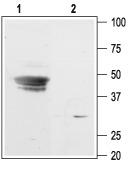
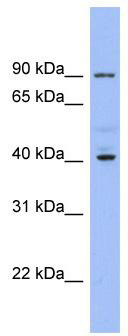
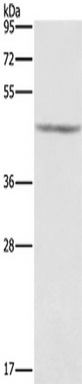
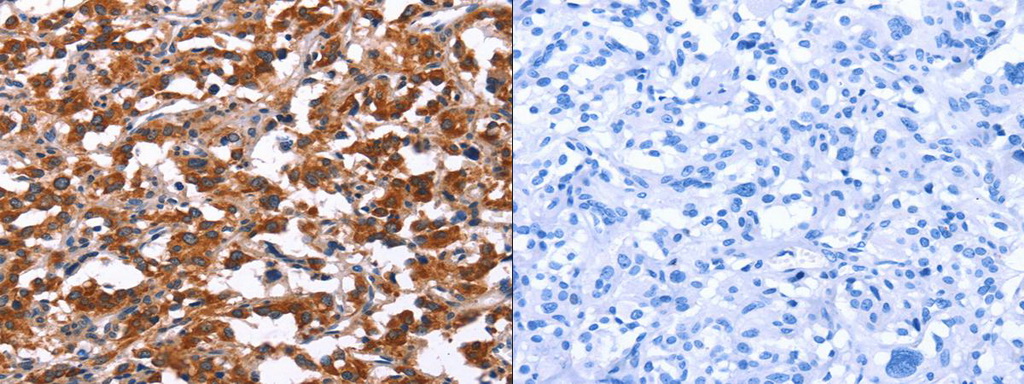
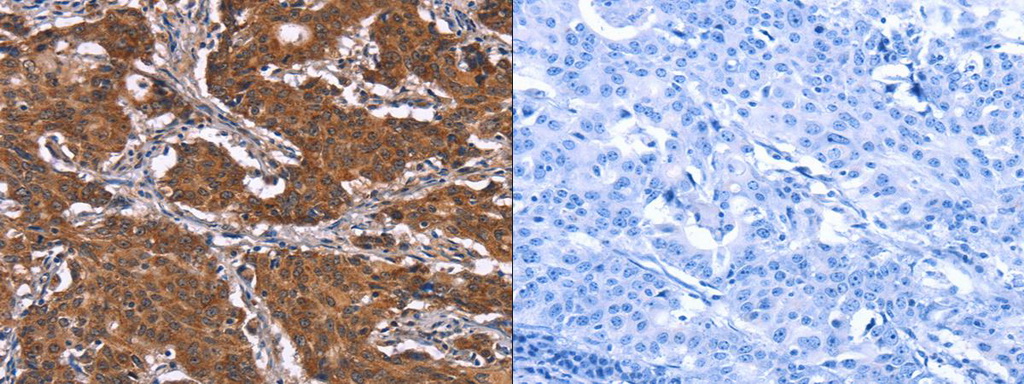
Primary Antibodies
| Catalog No. | Host | Iso. | Clone | Pres. | React. | Applications | |
|---|---|---|---|---|---|---|---|
| TA328944 | KCNJ9 antibody |
||||||
| Rabbit polyclonal Anti-Kir3.3 (GIRK3) | |||||||
 |
Rabbit | Purified | Rt | WB |
0.2 ml /
€585.00
|
||
| OriGene Technologies, Inc. | |||||||
| TA351217 | KCNJ9 antibody |
||||||
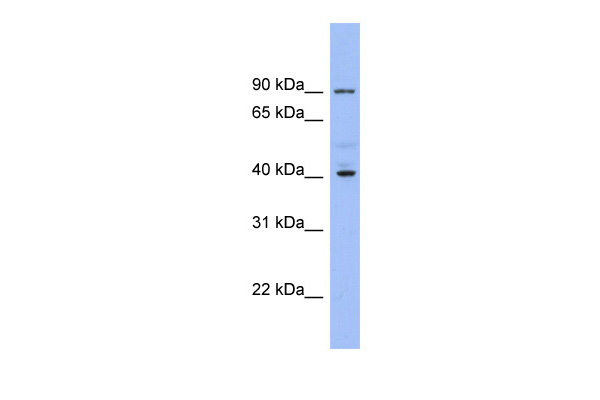
| Rabbit Polyclonal Anti-KCNJ9 Antibody | |||||||
 |
Rabbit | IgG | Purified | Hu, Ms, Rt | E, P, WB |
0.1 ml /
€335.00
|
|
| OriGene Technologies, Inc. | |||||||
 +2 additional images +2 additional images |
|||||||
| AP01403PU-N | KCNJ9 antibody |
||||||
 |
Rabbit | Aff - Purified | Hu, Ms, Rt | WB |
0.1 mg /
€370.00
|
||
| OriGene Technologies GmbH | |||||||
Proteins & Growth Factors
| Catalog No. | Species | Pres. | Purity | Source | |
|---|---|---|---|---|---|
| TP316336 | KCNJ9 |
||||
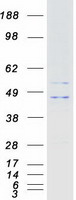
| Recombinant protein of human potassium inwardly-rectifying channel, subfamily J, member 9 (KCNJ9) | |||||
 |
Human | > 80 % Preparation: Recombint protein was captured through anti-DDK affinity column followed by conventiol chromatography steps. Purity Detail: > 80% as determined by SDS-PAGE and Coomassie blue staining. |
HEK293 cells |
20 µg /
€748.00
|
|
| OriGene Technologies, Inc. | |||||
Lysates
| Catalog No. | ||
|---|---|---|
| LY417612 | KCNJ9 overexpression lysate |
|
 |
0.1 mg /
€295.00
|
|
| OriGene Technologies, Inc. |
Mouse Lenti ORF Particles
| Catalog No. | ||
|---|---|---|
| MR205842L2V | Lenti ORF particles, Kcnj9 (GFP-tagged) - Mouse potassium inwardly-rectifying channel, subfamily J, member 9 (Kcnj9), 200 uL, >10^7 TU/mL |
|
|
200 µl /
€930.00
|
|
| OriGene Technologies, Inc. | ||
| MR205842L1V | Lenti ORF particles, Kcnj9 (Myc-DDK-tagged) - Mouse potassium inwardly-rectifying channel, subfamily J, member 9 (Kcnj9), 200 uL, >10^7 TU/mL |
|
|
200 µl /
€830.00
|
|
| OriGene Technologies, Inc. | ||
Rat Lenti ORF Particles
| Catalog No. | ||
|---|---|---|
| RR211506L2V | Lenti ORF particles, Kcnj9 (GFP-tagged ORF) - Rat potassium inwardly-rectifying channel, subfamily J, member 9 (Kcnj9), 200 uL, >10^7 TU/mL |
|
|
200 µl /
€930.00
|
|
| OriGene Technologies, Inc. | ||
| RR211506L1V | Lenti ORF particles, Kcnj9 (Myc-DDK-tagged ORF) - Rat potassium inwardly-rectifying channel, subfamily J, member 9 (Kcnj9), 200 uL, >10^7 TU/mL |
|
|
200 µl /
€830.00
|
|
| OriGene Technologies, Inc. | ||