KCNN3 antibody
Principal name
KCNN3 antibody
Alternative names for KCNN3 antibody
KCNN3, K3, SKCa3, SK3, Small conductance calcium-activated potassium channel protein 3
Available reactivities
Available hosts
Available applications
Western blot / Immunoblot (WB), Enzyme Immunoassay (E), Paraffin Sections (P)
Background of KCNN3 antibody
KCa2.3 is a member of the Ca2+-activated K+ channels family with small conductance that includes KCa2.1 (SK1) and KCa2.2 (SK2). The channel is voltage insensitive and is activated by intracellular Ca2+ in the submicromolar range. It has, though, a similar topology to that of voltage-dependent K+ channels (Kv channels), that is six transmembrane domains and intracellular N- and C-termini. The functiol channel of all the KCa2 family members is a multimeric protein composed of four pore-forming subunits. KCa2 channels are extremely sensitive to the levels of intracellular Ca2+ and concentrations as low as 300-700 nM can open the channels very rapidly (5-15 ms). Hence, the KCa2 channels are highly sensitive and fast Ca2+ sensors resembling other known Ca2+-binding proteins. This type of Ca2+-dependent activation is achieved by the constitutive binding of the KCa2 channels to calmodulin, a highly expressed Ca2+-binding protein via a calmodulin-binding domain situated at the cytoplasmic C-termini. Pharmacologically, the KCa2 channels are the only known targets of the bee venom toxin Apamin, with KCa2.1 being the less sensitive, KCa2.2 the most sensitive and KCa2.3 showing intermediate sensitivity. KCa2.3 is predomintly expressed in the nervous system although expression in endothelial cells, heart and liver have been described. KCa2.3 is known to be involved in the regulation of neurol excitability. They do so mainly via a phenomenon known as afterhyperpolarization in which KCa2 channels open in response to increased intracellular Ca2+ concentrations that result from the entry of extracellular Ca2+ through voltage-dependent Ca2+ channels during action potentials. In this way, KCa2 channels effectively form a Ca2+-mediated feedback loop. KCa2.3 is involved in the control of firing rate and subsequent dopamine secretion from midbrain dopaminergic neurons. Since malfunction of these neurons is involved in several pathological disorders such as Parkinson’s disease and schizophrenia, modulators of the KCa2.3 channels have been proposed to be of therapeutic value in these diseases.
General readings
Kolski-Andreaco,A., et al., (2004) J. Biol. Chem. 279 (8), 6893-6904
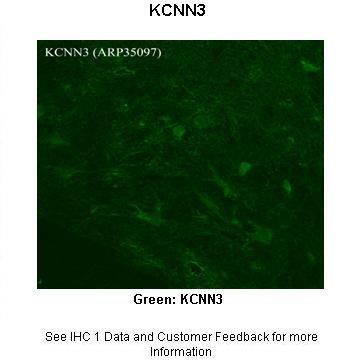

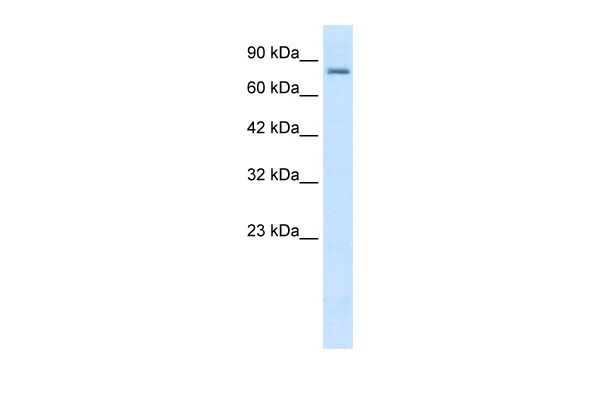
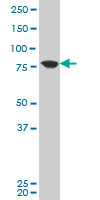

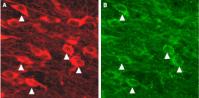
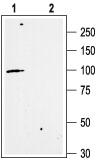


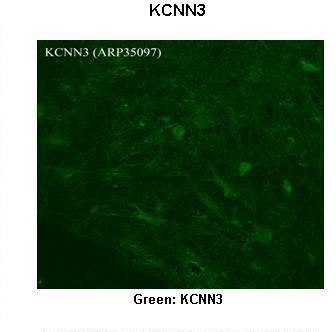
Primary Antibodies
| Catalog No. | Host | Iso. | Clone | Pres. | React. | Applications | |
|---|---|---|---|---|---|---|---|
| TA328622 | KCNN3 antibody |
||||||
| Rabbit Polyclonal Anti-KCa2.3 (SK3) (N-term) | |||||||
 |
Rabbit | Purified | Hu, Ms, Rt | WB |
0.2 ml /
€585.00
|
||
| OriGene Technologies, Inc. | |||||||
 +1 additional image +1 additional image |
|||||||
| TA328623 | KCNN3 antibody |
||||||
| Rabbit Polyclonal Anti-KCa2.3 (C-term) | |||||||
 |
Rabbit | Purified | Hu, Ms, Rt | WB |
0.2 ml /
€585.00
|
||
| OriGene Technologies, Inc. | |||||||
Lysates
| Catalog No. | ||
|---|---|---|
| LY406879 | KCNN3 overexpression lysate |
|
 |
0.1 mg /
€295.00
|
|
| OriGene Technologies, Inc. |
Rat Lenti ORF Particles
| Catalog No. | ||
|---|---|---|
| RR215450L2V | Lenti ORF particles, Kcnn3 (GFP-tagged ORF) - Rat potassium intermediate/small conductance calcium-activated channel, subfamily N, member 3 (Kcnn3), 200 uL, >10^7 TU/mL |
|
|
200 µl /
€1,520.00
|
|
| OriGene Technologies, Inc. | ||
| RR215450L1V | Lenti ORF particles, Kcnn3 (Myc-DDK-tagged ORF) - Rat potassium intermediate/small conductance calcium-activated channel, subfamily N, member 3 (Kcnn3), 200 uL, >10^7 TU/mL |
|
|
200 µl /
€1,360.00
|
|
| OriGene Technologies, Inc. | ||