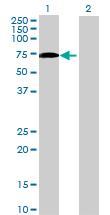
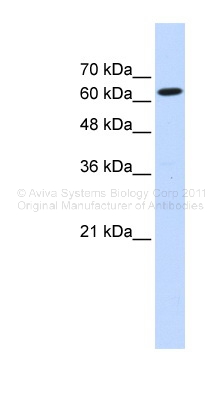
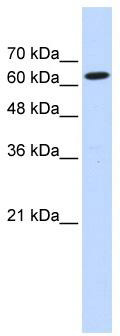
Ligatin antibody
Principal name
Ligatin antibody
Alternative names for Ligatin antibody
LGTN, HCA56, Hepatocellular carcinoma-associated antigen 56
Ncbi ID
9606, NP_008824, NP_001188407.1, NM_006893, NP_001129542.1, NM_001136070, NM_010709
Available reactivities
Available hosts
Available applications
Enzyme Immunoassay (E), Western blot / Immunoblot (WB), ELISA (detection) (E(detection))
Background of Ligatin antibody
LGTN is a protein receptor that localizes phosphoglycoproteins within endosomes and at the cell periphery. This trafficking receptor for phosphoglycoproteins may play a role in neuroplasticity by modulating cell-cell interactions, intracellular adhesion, and protein binding at membrane surfaces. In hippocampal neurons, long-lasting down-regulation of ligatin mRNA levels occurs via post-transcriptional RNA processing following glutamate receptor activation. This protein contains single PUA and SUI1 domains and these domains may function in RNA binding and translation initiation, respectively.This gene encodes a protein receptor that localizes phosphoglycoproteins within endosomes and at the cell periphery. This trafficking receptor for phosphoglycoproteins may play a role in neuroplasticity by modulating cell-cell interactions, intracellular adhesion, and protein binding at membrane surfaces. In hippocampal neurons, long-lasting down-regulation of ligatin mRNA levels occurs via post-transcriptional RNA processing following glutamate receptor activation. This protein contains single PUA and SUI1 domains and these domains may function in RNA binding and translation initiation, respectively.
General readings
Beausoleil,S.A., (2004) Proc. Natl. Acad. Sci. U.S.A. 101 (33), 12130-12135
Proteins & Growth Factors
| Catalog No. | Species | Pres. | Purity | Source | |
|---|---|---|---|---|---|
| TP301726 | Ligatin |
||||
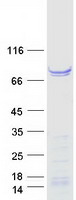
| Recombinant protein of human ligatin (LGTN) | |||||
 |
Human | > 80 % Preparation: Recombint protein was captured through anti-DDK affinity column followed by conventiol chromatography steps. Purity Detail: > 80% as determined by SDS-PAGE and Coomassie blue staining. |
HEK293 cells |
20 µg /
€748.00
|
|
| OriGene Technologies, Inc. | |||||
Lysates
| Catalog No. | ||
|---|---|---|
| LY416334 | EIF2D overexpression lysate |
|
 |
0.1 mg /
€295.00
|
|
| OriGene Technologies, Inc. |
Mouse Lenti ORF Particles
| Catalog No. | ||
|---|---|---|
| MR208977L2V | Lenti ORF particles, Eif2d (GFP-tagged) - Mouse eukaryotic translation initiation factor 2D (Eif2d), transcript variant 1, 200 uL, >10^7 TU/mL |
|
|
200 µl /
€1,290.00
|
|
| OriGene Technologies, Inc. | ||
| MR212412L2V | Lenti ORF particles, Eif2d (GFP-tagged) - Mouse eukaryotic translation initiation factor 2D (Eif2d), transcript variant 2, 200 uL, >10^7 TU/mL |
|
|
200 µl /
€1,250.00
|
|
| OriGene Technologies, Inc. | ||
| MR208977L1V | Lenti ORF particles, Eif2d (Myc-DDK-tagged) - Mouse eukaryotic translation initiation factor 2D (Eif2d), transcript variant 1, 200 uL, >10^7 TU/mL |
|
|
200 µl /
€1,160.00
|
|
| OriGene Technologies, Inc. | ||
| MR212412L1V | Lenti ORF particles, Eif2d (Myc-DDK-tagged) - Mouse eukaryotic translation initiation factor 2D (Eif2d), transcript variant 2, 200 uL, >10^7 TU/mL |
|
|
200 µl /
€1,120.00
|
|
| OriGene Technologies, Inc. | ||