MORF4 antibody
Principal name
MORF4 antibody
Alternative names for MORF4 antibody
CSR, CSRB, SEN, SEN1, mortality factor 4
SwissProt ID
Gene ID
10934 (MORF4)
Available reactivities
Available hosts
Available applications
Western blot / Immunoblot (WB), ELISA (detection) (E(detection)), Immunocytochemistry/Immunofluorescence (ICC/IF), Paraffin Sections (P), Enzyme Immunoassay (E)
Background of MORF4 antibody
Cellular senescence, the terminal nondividing state that normal cells enter following completion of their proliferative potential, is the dominant phenotype in hybrids of normal and immortal cells. Fusions of immortal human cell lines with each other have led to their assignment to 1 of several complementation groups. MORF4 is a gene on chromosome 4 that induces a senescent-like phenotype in cell lines assigned to complementation group B.Cellular senescence, the terminal nondividing state that normal cells enter following completion of their proliferative potential, is the dominant phenotype in hybrids of normal and immortal cells. Fusions of immortal human cell lines with each other have led to their assignment to 1 of several complementation groups. MORF4 is a gene on chromosome 4 that induces a senescent-like phenotype in cell lines assigned to complementation group B.[supplied by OMIM].
General readings
1. Bowman,B.R., Moure,C.M., Kirtane,B.M., Welschhans,R.L., Tominaga,K., Pereira-Smith,O.M. and Quiocho,F.A.
Multipurpose MRG domain involved in cell senescence and proliferation exhibits structural homology to a DNA-interacting domain
2. Pardo,P.S., Leung,J.K., Lucchesi,J.C. and Pereira-Smith,O.M., et al.
MRG15, a novel chromodomain protein, is present in two distinct multiprotein complexes involved in transcriptional activation
3. Yochum,G.S. and Ayer,D.E., et al.
Role for the mortality factors MORF4, MRGX, and MRG15 in transcriptional repression via associations with Pf1, mSin3A, and Transducin-Like Enhancer of Split
4. Leung,J.K., Berube,N., Venable,S., Ahmed,S., Timchenko,N. and Pereira-Smith,O.M.
MRG15 activates the B-myb promoter through formation of a nuclear complex with the retinoblastoma protein and the novel protein PAM14
5. Bertram,M.J., Berube,N.G., Hang-Swanson,X., Ran,Q., Leung,J.K., Bryce,S., Spurgers,K., Bick,R.J., Baldini,A., Ning,Y., Clark,L.J.,, et al.
Identification of a gene that reverses the immortal phenotype of a subset of cells and is a member of a novel family of transcription factor-like genes
6. , Bertram M.J., Berube N.G., Hang-Swanson X., Ran Q., Leung J.K., Bryce S., Spurgers K., Bick R.J., Baldini A., Ning Y., et al.
Identification of a gene that reverses the immortal phenotype of a subset of cells and is a member of a novel family of transcription factor-like genes.
7. , D'Esposito M., Cocchia M., Matarazzo M.R., Macmillan S., Mazzarella R.
Two human homologs of the Drosophila dosage compensation gene msl-3 are located on the X chromosome.
8. , Wan D., Gong Y., Qin W., Zhang P., Li J., Wei L., Zhou X., Li H., Qiu X., Zhong F., et al.
Large-scale cDNA transfection screening for genes related to cancer development and progression.
9. , Guo S., Tong T., Zhang Z.
Cloning and identification of cellular senescence associated genes from fibroblasts 2BS.
10. , Zhang Q.-H., Ye M., Wu X.-Y., Ren S.-X., Zhao M., Zhao C.-J., Fu G., Shen Y., Fan H.-Y., Lu G., et al.
Cloning and functional analysis of cDNAs with open reading frames for 300 previously undefined genes expressed in CD34+ hematopoietic stem/progenitor cells.
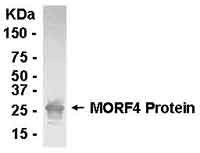
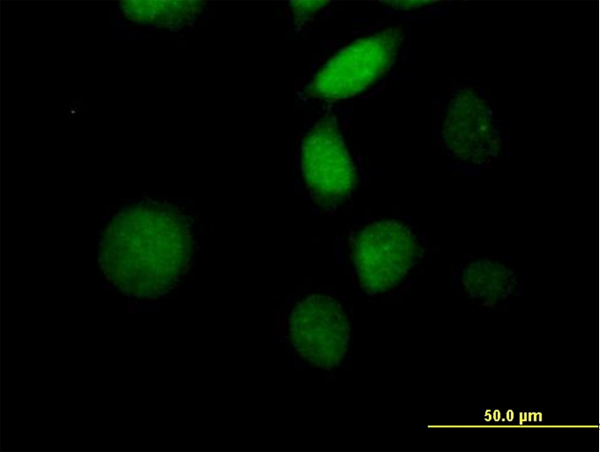
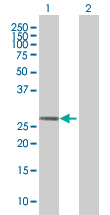

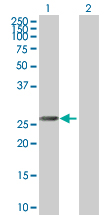

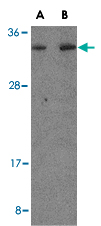
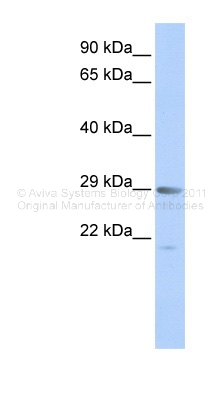
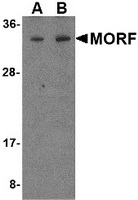
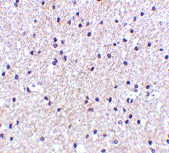
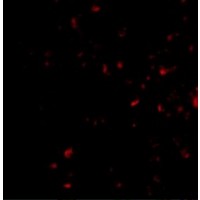
Primary Antibodies
| Catalog No. | Host | Iso. | Clone | Pres. | React. | Applications | |
|---|---|---|---|---|---|---|---|
| TA306449 | MORF4 (N-term) antibody |
||||||
| Rabbit Polyclonal MORF4 Antibody | |||||||
 |
Rabbit | Aff - Purified | Hu, Ms, Rt | E, ICC/IF, P, WB |
0.1 mg /
€415.00
|
||
| OriGene Technologies, Inc. | |||||||
 +2 additional images +2 additional images |
|||||||

