PDE6G antibody
Principal name
PDE6G antibody
Alternative names for PDE6G antibody
Phosphodiesterase 6G, Phosphodiesterase-6G cGMP-specific, PDEG, GMP-PDE gamma, PDE6 gamma, Phosphodiesterase 6 gamma, Retinal rod rhodopsin-sensitive cGMP 3',5'-cyclic phosphodiesterase subunit gamma
SwissProt ID
P04972 (Bovin), P09174 (Mouse), P18545 (Human), P54827 (Canfa), P61248 (Felca), Q9EQQ8 (Cavpo)
Ncbi ID
NP_002593, NP_002593.1, NM_002602, NP_036197.1, BC014723, NM_012065
Available reactivities
Available hosts
Available applications
Western blot / Immunoblot (WB), Flow Cytometry (F), Paraffin Sections (P)
Background of PDE6G antibody
The retinal cone and rod photoreceptor cells can directly stimulate and response by photons of the light. Upon light stimulation these cells undergo a highly regulated cascade of events that leads to changes in the photoreceptor membrane potentials and subsequent neurotransmitter release. The key component of photo transduction in retina is retinal specific cGMP-dependent phosphodiesterases type 6 (PDE6s). These PDEs convert cGMP in to GMP when activated by the G-protein transducin and caused a closer of the cGMP gated ion channels, reduced Na+ and Ca++ influx and hyper polarization of the photoreceptor cells. Rodhopsin and PDE6 are also co-localized in the internal membraneous disk of the photoreceptor cells allowing most efficient transfer of light signal from one protein to other. The retinal phosphodiesterses are multimeric proteins consisting of catalytic and inhibitory subunits. The large alfa and beta (a and b) subunits of the rod and cone specific PDE6 dimerizes to form the catalytic complex of the PDE6 isozyme. The smaller gamma subunit serves as an inhibitor for the rod and cone phosphodiesterses (1). There are 3 subtypes of PDE6 found in rod and cone cells, PDE6g PDE6b and an inhibitory PDE6g. The rod and cone PDEs differ significantly in subunit compositions, sensitivity to transducin, and cGP binding properties (2). The PDE6a and b forms have 2 non catalytic binding cGMP sites; the cone biding site has significantly lower Ki for cGMP that the rod enzymes. There is significant homology between a and b subunits in the catalytic and GAF binding domains.
Both PDE6a and PDE6 b are post-translationally modified, PDE6b is farnsylated and beta subunit is gernylgernylated (3). Generally, these modifications will allow proteins to be anchored to the membranes, incase of PDE6, despite 2 lipid modifications the PDE can easily be removed form membranes by detergent free hypotonic buffers. The PDE6 can be localized in both membrane and cytosolic compartment, the cytosolic PDE6 has been show to be associated with a 17 kDa delta subunit (4). The role of delta subunit in PDE6 functioning is not fully understood. It been hypothesized that delta subunit might be playing a role in PDE6 solubility in the photoreceptor cells. The PDE6b is a 103-105 kDa protein (858 amino acids) with 2 GAF and one PDEase catalytic domain. The inhibitory subunit (PDE6g) is a 87 amino acid peptide with an approximate molecular weight of 11kDa. The association of PDE6g subunit suppresses the PDE mediated cGMP hydrolysis.
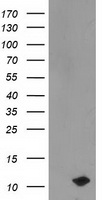

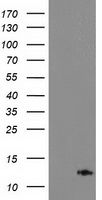

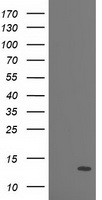
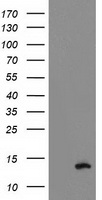
Primary Antibodies
| Catalog No. | Host | Iso. | Clone | Pres. | React. | Applications | |
|---|---|---|---|---|---|---|---|
| TA503686 | PDE6G antibody |
||||||
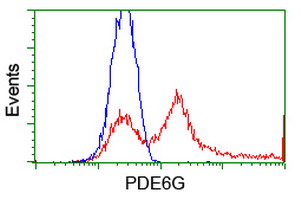
| PDE6G (PDE6 gamma) mouse monoclonal antibody, clone OTI1F3 (formerly 1F3) | |||||||
 |
Mouse | IgG2a | OTI1F3 | Purified | Hu | F, WB |
0.1 ml /
€360.00
|
| OriGene Technologies, Inc. | |||||||
 +1 additional image +1 additional image |
|
||||||
| TA503705 | PDE6G antibody |
||||||
| PDE6G (PDE6 gamma) mouse monoclonal antibody, clone OTI1H7 (formerly 1H7) | |||||||
 |
Mouse | IgG2a | OTI1H7 | Purified | Hu | WB |
0.1 ml /
€360.00
|
| OriGene Technologies, Inc. | |||||||
|
|||||||
| TA503736 | PDE6G antibody |
||||||
| PDE6G (PDE6 gamma) mouse monoclonal antibody, clone OTI2F5 (formerly 2F5) | |||||||
 |
Mouse | IgG2b | OTI2F5 | Purified | Hu | P, WB |
0.1 ml /
€360.00
|
| OriGene Technologies, Inc. | |||||||
| +1 additional image |
|
||||||
| TA503739 | PDE6G antibody |
||||||
| PDE6G (PDE6 gamma) mouse monoclonal antibody, clone OTI1E11 (formerly 1E11) | |||||||
 |
Mouse | IgG1 | OTI1E11 | Purified | Hu | F, WB |
0.1 ml /
€379.00
|
| OriGene Technologies, Inc. | |||||||
| +1 additional image |
|
||||||

Proteins & Growth Factors
| Catalog No. | Species | Pres. | Purity | Source | |
|---|---|---|---|---|---|
| TP316236 | PDE6G (transcript variant 1) |
||||
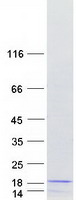
| Recombinant protein of human phosphodiesterase 6G, cGMP-specific, rod, gamma (PDE6G), transcript variant 1 | |||||
 |
Human | > 80 % Preparation: Recombint protein was captured through anti-DDK affinity column followed by conventiol chromatography steps. Purity Detail: > 80% as determined by SDS-PAGE and Coomassie blue staining. |
HEK293 cells |
20 µg /
€748.00
|
|
| OriGene Technologies, Inc. | |||||
Lysates
| Catalog No. | ||
|---|---|---|
| LY419220 | PDE6G overexpression lysate |
|
 |
0.1 mg /
€295.00
|
|
| OriGene Technologies, Inc. |
Mouse Lenti ORF Particles
| Catalog No. | ||
|---|---|---|
| MR200198L2V | Lenti ORF particles, Pde6g (GFP-tagged) - Mouse phosphodiesterase 6G, cGMP-specific, rod, gamma (Pde6g), 200 uL, >10^7 TU/mL |
|
|
200 µl /
€930.00
|
|
| OriGene Technologies, Inc. | ||
| MR200198L1V | Lenti ORF particles, Pde6g (Myc-DDK-tagged) - Mouse phosphodiesterase 6G, cGMP-specific, rod, gamma (Pde6g), 200 uL, >10^7 TU/mL |
|
|
200 µl /
€830.00
|
|
| OriGene Technologies, Inc. | ||