RAPGEF4 antibody
Principal name
RAPGEF4 antibody
Alternative names for RAPGEF4 antibody
CGEF2, EPAC2, EPAC 2, cAMP-GEFII, Rap guanine nucleotide exchange factor 4, Exchange factor directly activated by cAMP 2, Exchange protein directly activated by cAMP 2, cAMP-regulated guanine nucleotide exchange factor II
Ncbi ID
9606, NP_001093867, NP_001093867.1, NP_008954, NP_001191094.1, NM_019688, NM_001100397
Available reactivities
Available hosts
Available applications
Enzyme Immunoassay (E), Western blot / Immunoblot (WB), ELISA (detection) (E(detection)), Paraffin Sections (P)
Background of RAPGEF4 antibody
General secondary messenger cAMP levels are altered by many extracellular physiological signals including neurotransmitters, immunomodulators and hormones via the activation of G-protein coupled receptor (GPCR) activation. Activation of GPCRs by ligand interaction stimulates the heterotrimeric G-proteins thereby increasing the activity of one or more subtypes of adenylate cyclases to increase the formation of cAMP. The increased intracellular levels of cAMP transduce the signal transduction via protein kinase A and via small GTPase, RAP 1 (1,2). The activation of RaP1 by cAMP is independent f PKA and is mediated by recently discovered family of guanine nucleotide exchange factors (GEFs) called cAMP-GEFs or Epacs. The Epac signaling therefore represent a novel mechanism for cAMP signaling with in the cAMP cascade.
There are 2 members of the Epac family, Epac1 and Epac 2. Both proteins are multidomain proteins containing an autoinhibitory cAMP-binding domain that inhibits the catalytic region and a DEP domain (dishevelled, Egl-10 and pleckstrin homology domain) targeting the membrane anchors (3). EPAC2 has an additional cAMP-binding site in its N-terminus that binds cAMP with low affinity [2]. EPAC1 mRNA is broadly expressed, with particularly high levels occurring in the thyroid, ovary, kidney and certain brain regions, whereas expression of EPAC2 mRNA appears to be restricted to the brain and adrenal glands (4, 5). Epac 1 and Epac 2 also interact with light chain 2 (LC2) or MAP1A that serves as a scaffolding structure to stabilize the signal transduction complex (6).
General readings
Ueno H, Shibasaki T, Iwanaga T, et al. Characterization of the gene EPAC2: structure, chromosomal localization, tissue expression, and identification of the liver-specific isoform. Genomics 2001; 78:91-8.

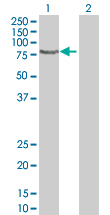
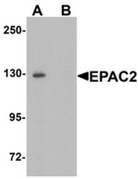
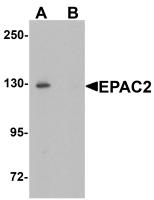
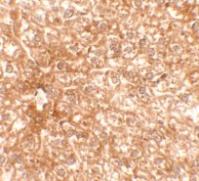
Western blot analysis in rat liver tissue lysate with RAPGEF4 / EPAC2 antibody Cat.-No. AP55604PU-N at
1 μg/ml in (A) the absence and (B) the presence of blocking peptide.
Primary Antibodies
| Catalog No. | Host | Iso. | Clone | Pres. | React. | Applications | |
|---|---|---|---|---|---|---|---|
| TA319831 | RAPGEF4 (N-term) antibody |
||||||
| Rabbit Polyclonal EPAC2 Antibody | |||||||
 |
Rabbit | IgG | Aff - Purified | Hu, Ms, Rt | P, WB |
0.1 mg /
€415.00
|
|
| OriGene Technologies, Inc. | |||||||
 +2 additional images +2 additional images |
|||||||
Proteins & Growth Factors
| Catalog No. | Species | Pres. | Purity | Source | |
|---|---|---|---|---|---|
| TP305335 | RAPGEF4 (transcript variant 1) |
||||
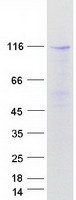
| Recombinant protein of human Rap guanine nucleotide exchange factor (GEF) 4 (RAPGEF4), transcript variant 1 | |||||
 |
Human | > 80 % Preparation: Recombint protein was captured through anti-DDK affinity column followed by conventiol chromatography steps. Purity Detail: > 80% as determined by SDS-PAGE and Coomassie blue staining. |
HEK293 cells |
20 µg /
€788.00
|
|
| OriGene Technologies, Inc. | |||||