TM4SF4 antibody
Principal name
TM4SF4 antibody
Alternative names for TM4SF4 antibody
ILTMP, IL-TMP, Transmembrane 4 L6 family member 4, Intestine and liver tetraspan membrane protein
Ncbi ID
Available reactivities
Available hosts
Available applications
Western blot / Immunoblot (WB), Enzyme Immunoassay (E)
Background of TM4SF4 antibody
TM4SF4 is a member of the transmembrane 4 superfamily, also known as the tetraspanin family. Most of these members are cell-surface proteins that are characterized by the presence of four hydrophobic domains. The proteins mediate signal transduction events that play a role in the regulation of cell development, activation, growth and motility. This protein is a cell surface glycoprotein that can regulate cell proliferation.The protein encoded by this gene is a member of the transmembrane 4 superfamily, also known as the tetraspanin family. Most of these members are cell-surface proteins that are characterized by the presence of four hydrophobic domains. The proteins mediate signal transduction events that play a role in the regulation of cell development, activation, growth and motility. This encoded protein is a cell surface glycoprotein that can regulate cell proliferation. The use of alternate polyadenylation sites has been found for this gene.
General readings
Strausberg,R.L., J. Cell. Sci. 114 (PT 23), 4143-4151 (2001)


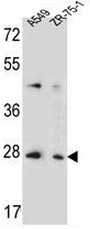
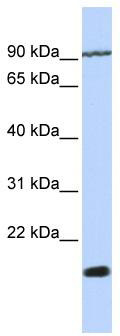
Primary Antibodies
| Catalog No. | Host | Iso. | Clone | Pres. | React. | Applications | |
|---|---|---|---|---|---|---|---|
| AP54133PU-N | TM4SF4 (N-term) antibody |
||||||
 |
Rabbit | Ig | Purified | Hu, Ms | WB |
0.4 ml /
€415.00
|
|
| OriGene Technologies GmbH | |||||||
 +1 additional image +1 additional image |
|||||||

