URM1 antibody
Principal name
URM1 antibody
Alternative names for URM1 antibody
URM-1, Ubiquitin-related modifier 1, C9orf74, YIL008W
Ncbi ID
NP_012258.1, 9606, 4932, NP_001129419, NP_112176, NP_001129419.1, NP_080891.1, NM_026615, NM_030914, NM_001135947
Available reactivities
Available hosts
Available applications
Enzyme Immunoassay (E), Western blot / Immunoblot (WB), Paraffin Sections (P)
Background of URM1 antibody
- Kit Component:
- - KN318751G1, Urm1 gRNA vector 1 in pCas-Guide vector
- KN318751G2, Urm1 gRNA vector 2 in pCas-Guide vector
- KN318751D, donor vector containing left and right homologous arms and Luciferase-Puro functional cassette
- GE100003, scramble sequence in pCas-Guide vector - CRISPR Manual:
- CRISPR/CAS9 Genome Editing Manual
General readings
Xu J., et al. (2006) Proc Natl Acad Sci U S A. 103(31):11625-30.
Schlieker CD., et al. (2008) Proc Natl Acad Sci U S A. 105(47):18255-60.
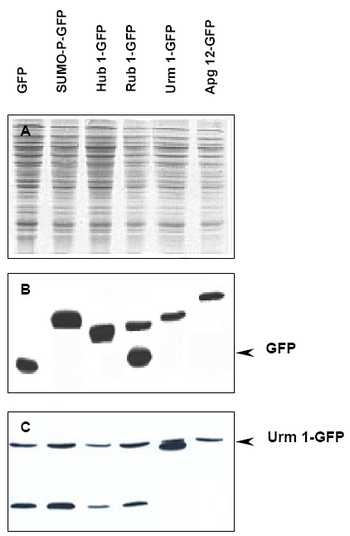
Figure 1. Immunoblot of Urm1 fusion protein: Anti- Urm1 antibody generated by immunization with recombinant yeast Urm1 was tested by immunoblot against yeast lysates expressing the Urm1-GFP fusion protein and other UBL fusion proteins. All UBLs possess limited homology to Ubiquitin and to each other, therefore it is important to know the degree of reactivity of each antibody against each UBL. Panel A shows total protein staining using ponceau. Panel B shows positions of free GFP or GFP containing recombinant proteins present in each lysate preparation after reaction with a 1:1,000 dilution of anti-GFP followed by reaction with a 1:15,000 dilution of HRP Donkey-a-Goat IgG. Panel C shows specific reaction with Urm1 using a 1:1,000 dilution of IgG fraction of Rabbit-anti- Urm1 (Yeast) followed by reaction with a 1:15,000 dilution of HRP Goat-a-Rabbit IgG. All primary antibodies were diluted in TTBS buffer supplemented with 5% non-fat milk and incubated with the membranes overnight at 4° C. Yeast lysate proteins were separated by SDS-PAGE using a 15% gel. This data indicates that anti-Urm1 is highly specific and does not cross react with other UBLs. Bands present in Panel C indicate that Urm1 and conjugated Urm1 is present in most yeast cell lysates albeit at significantly reduced levels relative to the Urm1-GFP transfected lysate. A chemiluminescence system was used for signal detection (Roche). Other detection systems will yield similar results. Data contributed by M. Malakhov, www.lifesensors.com, personal communication.
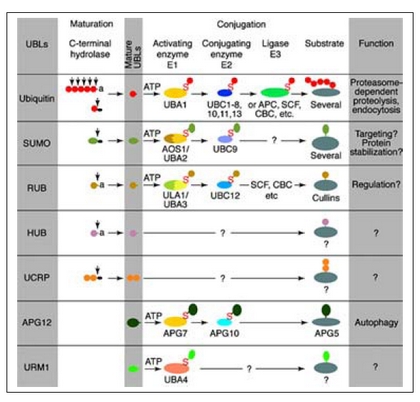
Figure 2. Conjugation pathways for ubiquitin and ubiquitin-like modifiers (UBLs). Most modifiers mature by proteolytic processing from inactive precursors (a; amino acid). Arrowheads point to the cleavage sites. Ubiquitin is expressed either as polyubiquitin or as a fusion with ribosomal proteins. Conjugation requires activating (E1) and conjugating (E2) enzymes that form thiolesters (S) with the modifiers. Modification of cullins by RUB involves SCF(SKP1/cullin-1/F-box protein) /CBC(cullin-2/elongin B/elonginC) -like E3 enzymes that are also involved in ubiquitination. In contrast to ubiquitin, the UBLs do not seem to form multi-UBL chains. UCRP(ISG15) resembles two ubiquitin moieties linked head-to-tail. Whether HUB1 functions as a modifier is currently unclear. APG12 and URM1 are distinct from the other modifiers because they are unrelated in sequence to ubiquitin. Data contributed by S.Jentsch, see reference 5.
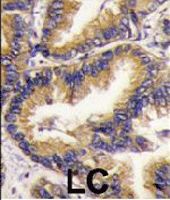
Formalin-fixed and paraffin-embedded human lung carcinoma tissue reacted with URM1 polyclonal antibody ( Cat # PAB3628 ) , which was peroxidase-conjugated to the secondary antibody, followed by DAB staining. This data demonstrates the use of this antibody for immunohistochemistry ; clinical relevance has not been evaluated.
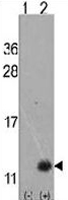
Western blot analysis of URM1 polyclonal antibody ( Cat # PAB3628 ) . 293 cell lysates ( 2 µg/lane ) either nontransfected ( Lane 1 ) or transiently transfected with the hURM1 gene ( Lane 2 ) ( Origene Technologies ) .
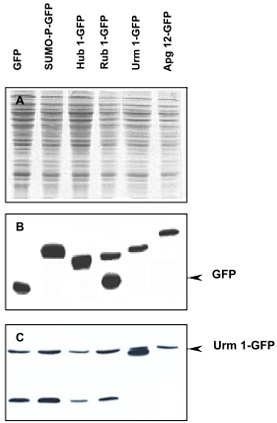
Immunoblot of Urm1 fusion protein.URM1 polyclonal antibody ( Cat # PAB11366 ) generated by immunization with recombinant yeast URM1 was tested by immunoblot against yeast lysates expressing the URM1-GFP fusion protein and other UBL fusion proteins.All UBLs possess limited homology to Ubiquitin and to each other, therefore it is important to know the degree of reactivity of each antibody against each UBL.Panel A shows total protein staining using ponceau.Panel B shows positions of free GFP or GFP containing recombinant proteins present in each lysate preparation after reaction with a 1:1,000 dilution of anti-GFP followed by reaction with a 1:15,000 dilution of HRP Donkey-a-Goat IgG MX.Panel C shows specific reaction with URM1 using a 1:1,000 dilution of URM1 polyclonal antibody ( Cat # PAB11366 ) ( Yeast ) followed by reaction with a 1:15,000 dilution of HRP Goat-a-Rabbit IgG MX.All primary antibodies were diluted in TTBS buffer supplemented with 5% non-fat milk and incubated with the membranes overnight at 4°C.Yeast lysate proteins were separated by SDS-PAGE using a 15% gel. This data indicates that anti-URM1 is highly specificand does not cross react with other UBLs.Bands present in Panel C indicate that URM1 and conjugated URM1 is present in most yeast cell lysates albeit at significantly reduced levels relative to the URM1-GFP transfected lysate.A chemiluminescence system was used for signal detection ( Roche ) .Data contributed by M. Malakhov, www.lifesensors.com, personal communication.
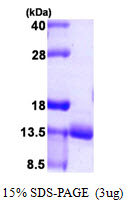

Recombinant human URM1, 1-101 aa, His-tagged
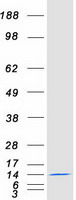
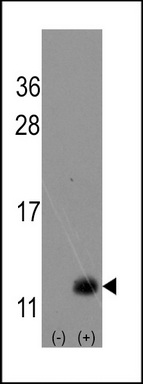
Western blot analysis of hURM1 (arrow) using rabbit polyclonal hURM1 Antibody (N-term) (Cat.#TA302028). 293 cell lysates (2 ug/lane) either nontransfected (Lane 1) or transiently transfected with the hURM1 gene (Lane 2) (Origene Technologies).
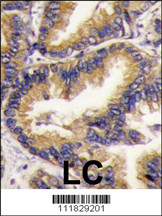
Formalin-fixed and paraffin-embedded human lung carcinoma tissue reacted with URM1 Antibody (N-term)(Cat.#TA302028), which was peroxidase-conjugated to the secondary antibody, followed by DAB staining. This data demonstrates the use of this antibody for immunohistochemistry; clinical relevance has not been evaluated.
Primary Antibodies
| Catalog No. | Host | Iso. | Clone | Pres. | React. | Applications | |
|---|---|---|---|---|---|---|---|
| TA302028 | URM1 antibody |
||||||
| Rabbit Polyclonal Antibody against URM1 (N-term) | |||||||
 |
Rabbit | Purified | Hu | P, WB |
0.4 ml /
€415.00
|
||
| OriGene Technologies, Inc. | |||||||
 +1 additional image +1 additional image |
|||||||
| R1200 | URM1 antibody |
||||||
 |
Rabbit | Purified | Ye | E, WB |
0.5 mg /
€590.00
|
||
| OriGene Technologies GmbH | |||||||
| +1 additional image |
|||||||
Proteins & Growth Factors
| Catalog No. | Species | Pres. | Purity | Source | |
|---|---|---|---|---|---|
| TP300854 | URM1 (transcript variant 1) |
||||
| Recombinant protein of human ubiquitin related modifier 1 homolog (S. cerevisiae) (URM1), transcript variant 1 | |||||
 |
Human | > 80 % Preparation: Recombint protein was captured through anti-DDK affinity column followed by conventiol chromatography steps. Purity Detail: > 80% as determined by SDS-PAGE and Coomassie blue staining. |
HEK293 cells |
20 µg /
€748.00
|
|
| OriGene Technologies, Inc. | |||||
Mouse Lenti ORF Particles
| Catalog No. | ||
|---|---|---|
| MR200310L2V | Lenti ORF particles, Urm1 (GFP-tagged) - Mouse ubiquitin related modifier 1 homolog (S. cerevisiae) (Urm1), 200 uL, >10^7 TU/mL |
|
 |
200 µl /
€930.00
|
|
| OriGene Technologies, Inc. | ||