EGF antibody
Principal name
EGF antibody
Alternative names for EGF antibody
Urogastrone, Epidermal growth factor, URG, HOMG4, Pro-epidermal growth factor
Ncbi ID
NP_001954, NP_001954.2, NP_036974, 10090, 9606, NP_034243, NP_036974.1, NM_001963, BC017681, NM_012842, NM_010113
Available reactivities
Available hosts
Available applications
Enzyme Immunoassay (E), Western blot / Immunoblot (WB), Immunocytochemistry/Immunofluorescence (ICC/IF), ELISA (detection) (E(detection)), Frozen Sections (C), ELISA (capture) (E(capture)), Paraffin Sections (P), Functional assay (FN), Neutralisation (NEUT), Flow Cytometry (F), Immunoprecipitation (IP), Dot blot (Dot)
Background of EGF antibody
Epidermal growth factor (EGF) is the founding member of the EGF family that also includes TGF., amphiregulin (AR), betacellulin (BTC), epiregulin(EPR), heparinbinding EGF-like growth factor (HB-EGF), epigen, and the neuregulins (NRG)1 through-6. Members of the EGF family share a structural motif, the EGF-like domain, which is characterized by three intramolecular disulfide bonds that are formed by six similarly spaced conserved cysteine residues . All EGF family members are synthesized as type I transmembrane precursor proteins that may contain several EGF domains in the extracellular region. The 1207 amino acid (aa) human EGF precursor contains nine EGF domains and nine LDLR class B repeats. The mature protein consists of 53 aa and is generated by proteolytic excision of the EGF domain proximal to the transmembrane region . EGF is present in various body fluids, including blood, milk, urine, saliva, seminal fluid, pancreatic juice, cerebrospinal fluid, and amniotic fluid . Four ErbB (HER) family receptor tyrosine kinases including EGFR/ErbB1, ErbB2, ErbB3 and ErbB4, mediate responses to EGF family members . These receptors undergo a complex pattern of ligand induced homoor heterodimerization to transducer EGF family signals . EGF binds ErbB1 and depending on the context, induces the formation of homodimers or heterodimers containing ErbB2. Dimerization results in autophosphorylation of the receptor at specific tyrosine residues to create docking sites for a variety of signaling molecules . Biological activities ascribed to EGF include epithelial development, angiogenesis, inhibition of gastric acid secretion, fibroblast proliferation, and colony formation of epidermal cells in culture.
General readings
Harris, R.C. et al. (2003) Exp. Cell Res. 284:2.
Carpenter, G. and S. Cohen, (1990) J. Biol. Chem. 265:7709.
Bell, G.I. et al. (1986) Nucl. Acids Res. 14:8427.
Carpenter, G. and Zendegui, J.G. (1986) Exp. Cell Res.164:1.
Jorissen, R.N. et al. (2003) Exp. Cell Res. 284:31.
Gamett, D.C. et al. (1997) J. Biol. Chem. 272:12052.
Qian, X. et al. (1994) Proc. Natl. Acad. Sci. 91:1500.
Qian, X. et al. (1999) J. Biol. Chem. 274:574.
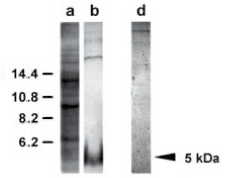
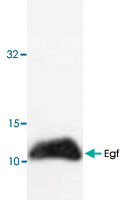
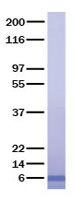
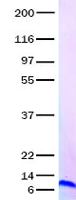
Lane a: Crude extract stained with Coomassie Brilliant Blue.
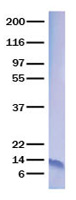
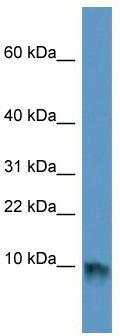
Lane b: AP02293SU detects a 5 kDa band which corresponds to a processed form of EGF from the 78 kDa precursor.
Lane d: AP02293SU preabsorbed with recombinant EGF precursor. Perovic-Ottstadt S et al. Eur J Biochem. 271:1924-1937.

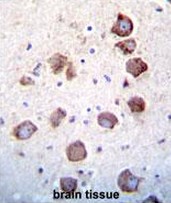
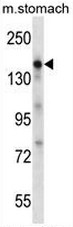
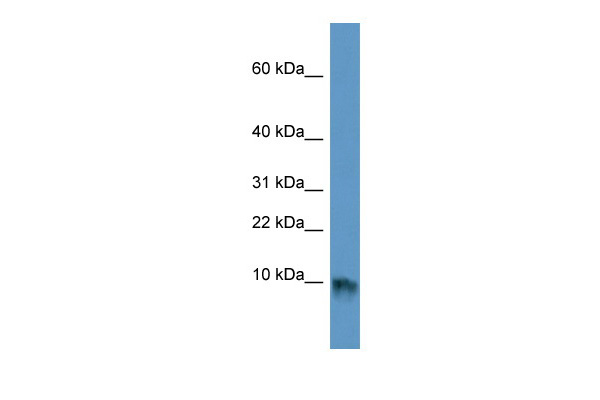

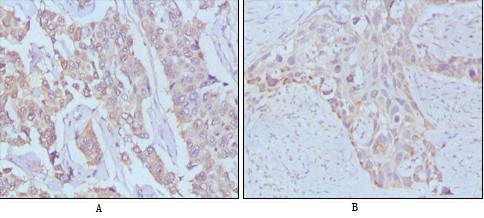

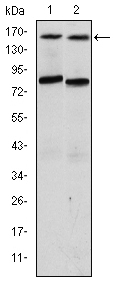
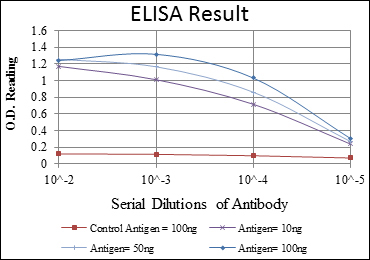

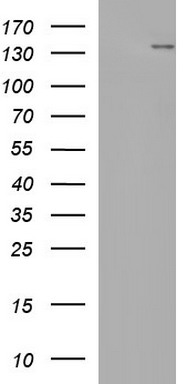
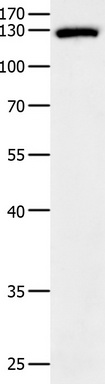
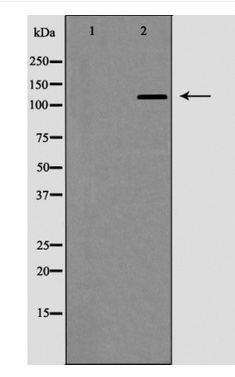
Immunoprecipitation of human EGF-R from A431 cells with 2 μg of AM26658SU-N (1), 10μg of AM26658SU-N (2) and mouse IgG (3). After immunoprecipitated with the antibody, immunocomplex was resolved on SDS-PAGE and immunoblotted with AM26658SU-N.



Proteins & Growth Factors
| Catalog No. | Species | Pres. | Purity | Source | |
|---|---|---|---|---|---|
| PR27007-100 | EGF |
||||
 |
Human | Purified | > 95 % | Pichia pastoris |
0.1 mg /
€190.00
|
| Neuromics Antibodies | |||||
| PR27007-500 | EGF |
||||
 |
Human | Purified | > 95 % | Pichia pastoris |
0.5 mg /
€290.00
|
| Neuromics Antibodies | |||||

