SCN1A antibody
Principal name
SCN1A antibody
Alternative names for SCN1A antibody
NAC1, SCN1, Sodium channel protein type 1 subunit alpha, Sodium channel protein type I subunit alpha, Voltage-gated sodium channel subunit alpha Nav1.1, Sodium channel protein brain I subunit alpha
Ncbi ID
Available reactivities
Available hosts
Available applications
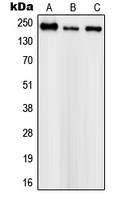
Paraffin Sections (P), Western blot / Immunoblot (WB), Enzyme Immunoassay (E), Frozen Sections (C), Immunocytochemistry/Immunofluorescence (ICC/IF), Immunoprecipitation (IP)
Background of SCN1A antibody
Voltage-gated sodium channels (v) are essential for the generation of action potentials and for cell excitability. v channels are activated in response to depolarization and selectively allow flow of + ions. To date, nine v a subunits have been cloned and med v1.1-v1.9. The v channels are classified into two groups according to their sensitivity to Tetrodotoxin (TTX): TTX-sensitive (v1.1, v1.2, v1.3, v1.4, v1.6 and v1.7) and TTX-resistant (v1.5, v1.8 and v1.9). Mammalian sodium channels are heterotrimers, composed of a central, pore-forming α subunit and two auxiliary β subunits. The expression of the α subunit isoform is developmentally regulated and tissue specific. + channels in the adult central nervous system and heart contain β1 through β4 subunits, whereas + channels in adult skeletal muscle have only the β1 subunit. v1.1 is a highly tetrodotoxin-sensitive channel and is broadly expressed in neurons. Mutations in V1.1 are associated with at least two forms of epilepsy. Gain-of-function missense mutations are a primary cause of generalized epilepsy with febrile seizures plus (GEFS+). Loss-of-function mutations cause severe myoclonic epilepsy of infancy (SMEI).






Primary Antibodies
| Catalog No. | Host | Iso. | Clone | Pres. | React. | Applications | |
|---|---|---|---|---|---|---|---|
| AP55276PU-N | SCN1A antibody |
||||||
 |
Rabbit | Purified | Hu, Ms, Rt | C, E, WB |
0.1 mg /
€450.00
|
||
| OriGene Technologies GmbH | |||||||

